Cranberry is mainly used as an adjunct in the prevention of recurrent urinary tract infections. Its benefits are attributed to proanthocyanidins, which interfere with the adhesion of uropathogemic bacteria to the bladder mucosa. These uropathogem strains rely on the adhesive capacity of type P fimbriae for colonization, the first step in an infectious process. The proanthocyanidins (PACs) especially type A present in the cranberry, as demonstrated by in vitro and in vivo experiments, act at the molecular level by inhibiting type R fimbriae thus preventing bacteria from adhering to cells and colonizing them. D-mannose is able to act in synergy with the proanthocyanidins contained in cranberry, in glove it has a high affinity for the iectin-jaannose-sensitive of many bacteria, including Escherichia coli.
D-Mannose, in fact, by binding to these lectins, present on the P-type fimbriae of these bacteria, counteracts the adhesion of the latter to the urinary mucous membranes, promoting their elimination through the urine.
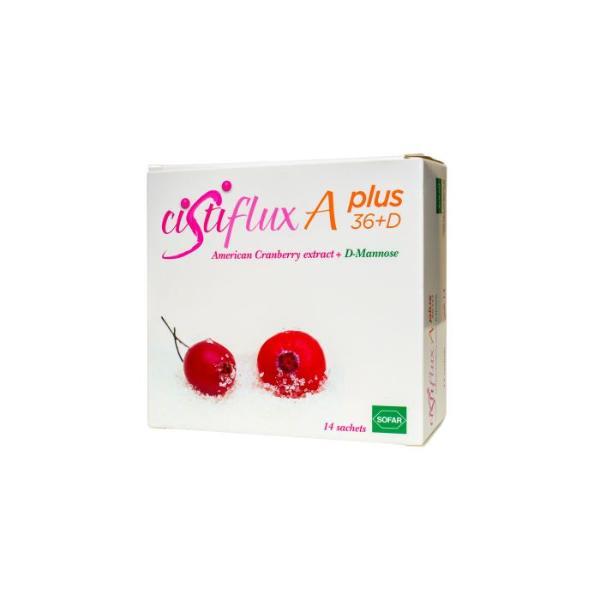
Medical device based on cranberry extract titrated in type A proanthocyanidins (36 mg per sachet) and D-mannose.
How should cistiflux A Plus 36 + D sachets be taken?
In a very simple way, just pour the contents of one sachet a day into a glass of natural water at room temperature and drink in small sips, preferably in the evening before going to bed, with an empty bladder and between meals. It is important to remember that, to promote urinary flow and, therefore, the elimination of bacteria present in the bladder, it is necessary to drink at least 1.5 - 2 liters of water throughout the day.